When Rhode Skin launched in 2022, it was a small, celebrity brand with only three products: Peptide Glazing Fluid, Peptide Lip Treatment, and Barrier Restore Cream. The Peptide Glazing Fluid sold out immediately and accumulated a 100,000-person waiting list. On Feb. 24, one of Rhode’s most notable products launched:
The Rhode Lip Case.
Hailey Bieber, founder and Chief Creative Officer of Rhode, described the process of inventing such a product as an “aha!” moment. From then on, influencers and celebrities alike flocked to snap that grey, rubber case onto their phones, with a matching lip treatment sliding right into place.
My initial exposure to Rhode Skin began with watching Formula One. In a sport so catered towards brands, luxury, and influence, Formula One brought many different companies to my attention. However, it wasn’t the drivers or the teams with the Rhode brand deal, but the models in the paddock with the little lip case on their phones.
Rhode Skin gave us fans a collaboration with influencer Alexandra Saint Mleux, a launch with Tate McRae as the face, and a promotion with Anok Yai as the model. And if you hadn’t seen Rhode before, I’m sure you did by the end of the Olympics, where gold medalist Sunisa Lee displayed her Rhode lip case while touching up her makeup. Faces around the world, in different corners of fame, were walking commercials for Hailey Bieber’s brand.
The influencer’s job worked according to the name; I was influenced. An Email in my inbox let me know that my package had been delivered. It was the 2nd time within the month I had dropped almost $100 on the brand, and I had no intent of holding back on ordering.
A new drop, a few limited edition items, and I was hooked on the thrill of spending. It didn’t matter that the lip tints were $20, and the lip liner–which I kept losing–was $24. The future and my financial responsibilities didn’t matter whenever there was a chance that a limited edition item would go out of stock.
When I made my first purchase from Rhode, I felt like it would make me “fit in.” This brand that many influencers around the world bought into seemed to be the key to feeling good about myself. It was almost as if it would make me suddenly gain confidence and popularity. I had coworkers asking me how the new lip treatment was and friends telling me the shade looked good on me. After that, I found myself constantly chasing this desire to fit in through my Rhode purchases.
That’s the entire point of the “beauty community” in general: making girls feel like they need to drop a part-time paycheck to feel confident in themselves and how they fit into society. This isn’t necessarily Rhode’s fault, but the nature of the market in general. When a beauty company is valued at $1 billion dollars, it shows that there’s necessity behind the products, because why else would that much money be spent on something to enhance your appearance?
Beauty standards have always been tied to wealth. In the 1920s, a tan began to be considered a symbol of wealth due to the Industrial Revolution. A nice, bronzed tan meant you could vacation. You didn’t have to stay inside a factory all day, working endlessly to make ends meet. Prior to that, being tan was seen as lower-class. It meant you were working outside, rather than having the ability to stay inside at your leisure. Similarly, being plus-sized was the standard simply due to the idea that you could afford a plentiful diet. In contrast, the standard today is a thin, toned body because, alongside a multitude of reasons, it means you can fit a balanced diet and gym time into your budget. These standards weren’t born from nothingness; they arose as the circumstances in which the poor has lived have changed.
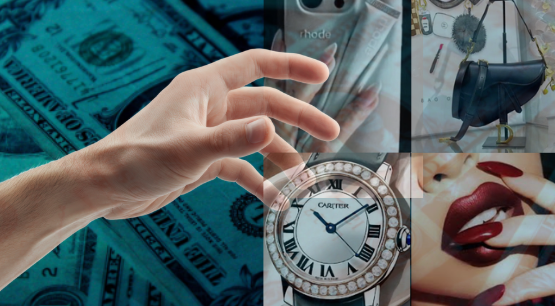
In a way, showing off your Rhode lip tint on the back of your phone–which happens to be magnetically held on by your Rhode lip case–is the same wealth indicator. You have the ability to drop $20 on a lip tint that could easily have been $10 from another brand. In many cases, when you willingly spend excessive amounts of money on a product, it begins to be less about the product itself and more about the name that you’re buying.
Whenever I’d buy a Rhode lip tint, I wasn’t just buying the product. I was buying a certain image. I was painting a picture of wealth: the idea that I had money. In reality, I just had spending issues and not a dime nor dollar in my savings. It was a look of privilege that I was subconsciously seeking. I was looking to show people that I bought something that they probably don’t have.
This desire isn’t particular to just me. It’s a common occurrence within this world. People want to look like they have privilege without speaking the word into existence. Many around the world would probably enjoy a mansion and a fancy car–maybe even a yacht, but the ability to own these items stems from having privilege.
For the average person, the yacht is too loud or the cars are too fancy. Realistically, you know you don’t need 10 bedrooms. You’d want the quiet privilege, the kind that quietly clasps around your wrist like a dainty Cartier bracelet or the small lip tint in your back pocket. The whole term “wealth whispers” speaks to you when picking out what name-brand shoes you’re going to wear. The average person doesn’t want to necessarily be loud about the privilege they have.
People constantly deny that they have it. With white people online claiming they’re “spicy white,” or refusing to accept the fact that white privilege is a thing, the word becomes almost unspoken in terms of self-reflection. It’s the big “P-word” that nobody wants to admit they have. Often, those born into higher classes exaggerate struggles to prove that “they worked very hard.” On social media, kids will flex their expensive designer items and then tell others to just “work harder,” as if their privilege hadn’t given them the boost required to afford to spend superfluously.
American economics is built on the idea that if you work hard, you will earn what you need. According to a study conducted by Stanford professor Brian S. Lowery, many who were born privileged often try to appear meritorious, as if they’ve worked hard to get to where they are in life.
Even those born into obvious wealth don’t like to utter the “P-word,” so someone who is seeking this privilege wouldn’t really admit: “Yeah, I want to look higher up and better than all of you.” I didn’t like admitting that, and I’m sure my friends wouldn’t like admitting it. It’s a truth that needs to come to light, especially for me, who doesn’t even have the money to waste the way I do.
When you overspend on these expensive, name-brand items, you begin to determine your worth based on it; it plants this idea in your mind that you’re less-than if you aren’t able to buy the new iPhone or the latest Coach purple, or that you’re missing another step in your 6-step skincare routine.
That’s what the beauty industry’s goal is: making you feel like you’re lacking something that their $80 product has the answer to. By basically sending the message that beauty can only be obtained through wealth and privilege, these brands are saying, “If you buy this overpriced product, you’ll look like this rich model that we decided represents our catalogue of even more overpriced products.”
The peptide glazing fluid, lip treatment, and barrier restore cream won’t give you the confidence you need to navigate life. They won’t magically make your problems disappear, especially when the pricing doesn’t even come close to aligning with your income. And, from my own experience, buying these products hasn’t given me the image I wanted. I wasn’t fitting in simply from my overconsumption of these products, because I hadn’t realised the people I thought I’d fit in with weren’t the ones with every Rhode product released. They weren’t the ones I interacted with on a day-to-day basis.
Nobody in my circle spent as much time, money, and effort on a single brand. They didn’t know the exact prices, the shade names, or the product names. It was the influencers that I was subconsciously wishing to “fit in” with. They were the ones who put the effort and time into these brands, with their packages sent straight to their door without them having to pay a dime. And instead of fitting in with the girls in LA or Monaco, I was unknowingly aligning myself with an image of privilege. Nothing about my overspending showed that I was cool or popular, but rather that I had used my privilege on pointless objects that did nothing to ruin my bank account.
As I began to understand that to cut back on my spending, I needed to recognise that I only wanted these items (the lip tints, $16 Rhode headbands, the phone cases) because of their popularity. You don’t need any of the products that are “popular” or that the influencers on TikTok are trying to sell you. By buying these items, you are not fixing a problem that you’ve been told you had: you’re giving the beauty industry more fuel to push the standards ever so higher.
And while I gave myself the goal to cut back on my spending, I still check the Rhode website, I still think about joining the waitlist for a new item, and I still use all the items I bought. This change in mind wasn’t sudden. There was no epiphany, no “aha!” moment. It began with a look at the bank account–which had a lower number than the last time I checked–and a look at myself and what I wanted. The new Rhode peptide lip tint would only give me a momentary spark of happiness before ultimately ending up in a mug on my dresser, waiting to be picked as my gloss for the day.