

I see AI everywhere. From AI generated slime videos, to the AI overview on Google, to chatbots, and more, and I’m sure you see it as well. It’s come to a point where it’s exhausting. It’s not only become more personal than ever with the usage of AI in our school, but it’s become more frustrating than ever, too.
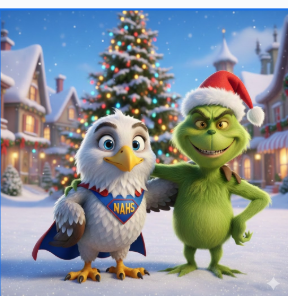
Every month, students receive a calendar in their email inbox, showing what days are A days or B days and promoting and informing students about events or general announcements. Oftentimes for announcements and events, there’s illustrations and photos to promote it, but upon looking closer, some look off. I first noticed this in the picture for winter spirit week.
The photo shows an Eagle with a cape that says NAHS with the Grinch wearing a Santa hat. Simple, silly, and fun, right? But I immediately identified this as AI, at first for the glossy cartoon art style, and then I noticed other signs as well.
For example, if you look at the brown part of the eagle’s wings (or, hands), there’s some white feathers, even though it doesn’t really make sense. No biggie, maybe the artist just didn’t think about it. In the bottom right corner, though, there’s a little star that makes no sense and has no reason to be there.
I looked it up, and turns out, it’s the Google Gemini symbol. It’s a watermark that’s put on the AI generated images Nano Banana, an AI image generator created by Google DeepMind, produces.
From there on, I was on the lookout for any other AI images that may be sent out. Then came the senior signing email.
In the senior signing email sent out in April, there weren’t any obvious signs of AI. The only real one was the blue basketball in the corner being odd, with the lines seeming to form a six-pack. But upon clicking on the picture and reading the file name, it says “ChatGPT Image.”
There were also clear signs of AI in an email announcing sports physicals and the Norristown Girls in Blue Kickoff Event email.
Some may not believe this is a big deal. After all, it’s really just promoting school events or important dates, so who cares? The poster and whatever else is used to promote the date doesn’t matter and if it’s an event, it doesn’t reflect the quality of the event itself. But it does to me.
Back in February of 2024, there was an event hosted in Glasgow, Scotland called “Willy’s Chocolate Experience” that was promoted using AI images, which was obvious by the glossy cartoon artstyle and misspellings in the posters. The experience ended up being lackluster, to say the least, with the props and event overall being unsatisfactory and leaving many who paid upset and saying they felt they’d been scammed.
It’s difficult to tell what’s real and what’s fake, and AI can make it even more difficult, as there’s many advertisements for products that’s either enhanced by AI or completely made by it.
Now, many won’t be fooled by it. After all, it’s usually very blatant. But sometimes, people are fooled. There’s always the possibility of someone deciding to buy it and getting a bad product, or sometimes even no product.
Why mention any of this? Because this directly influences how I see events and promotional material, as well as the companies and/or people behind it. This extends to our school.
AI being used to promote events, and inform of dress code changes, directly influences how I view the school, those in charge, and the events they’re announcing. Let’s use the senior signing as an example. When I saw something was attached to the email, I looked at that first, and upon determining it was AI, I disregarded the entire email. I didn’t even bother to look into what it was promoting—I immediately decided it wasn’t worth my time or attention. If they didn’t bother to put in the bare minimum of effort, why should I pretend they did and treat it the same as something that had genuine time and work put into it?
Something else is if something’s being promoted using AI, then I can’t help but wonder: why? My first thought is whoever’s running or hosting it either didn’t have the money, resources, or time for it. If they didn’t have the money or resources for the ad, who’s to say they have the money for the event they’re promoting? It’s now a risk for me to go to the event, especially if it costs a good chunk of my clams.
If they don’t have the money for ads, whoever’s hosting or promoting the event could take pictures of certain parts of it and put text over it using a free image editing software, which there are plenty of. They could even add little special effects and filters to make it more appealing!
If they don’t have a camera? You have a phone. No phone? Have a friend do it. No friends? A family member. No family members? You could probably find someone off Craigslist or Fiverr to take pictures for a couple smackeroos. There’s so many better solutions than AI!
Now, if they did have the money and resources for both the promotion and the event and just didn’t have the time, still, why should I buy a ticket or go? If they’re not willing to find time in the day to promote it, how can I trust they put any time into making it?
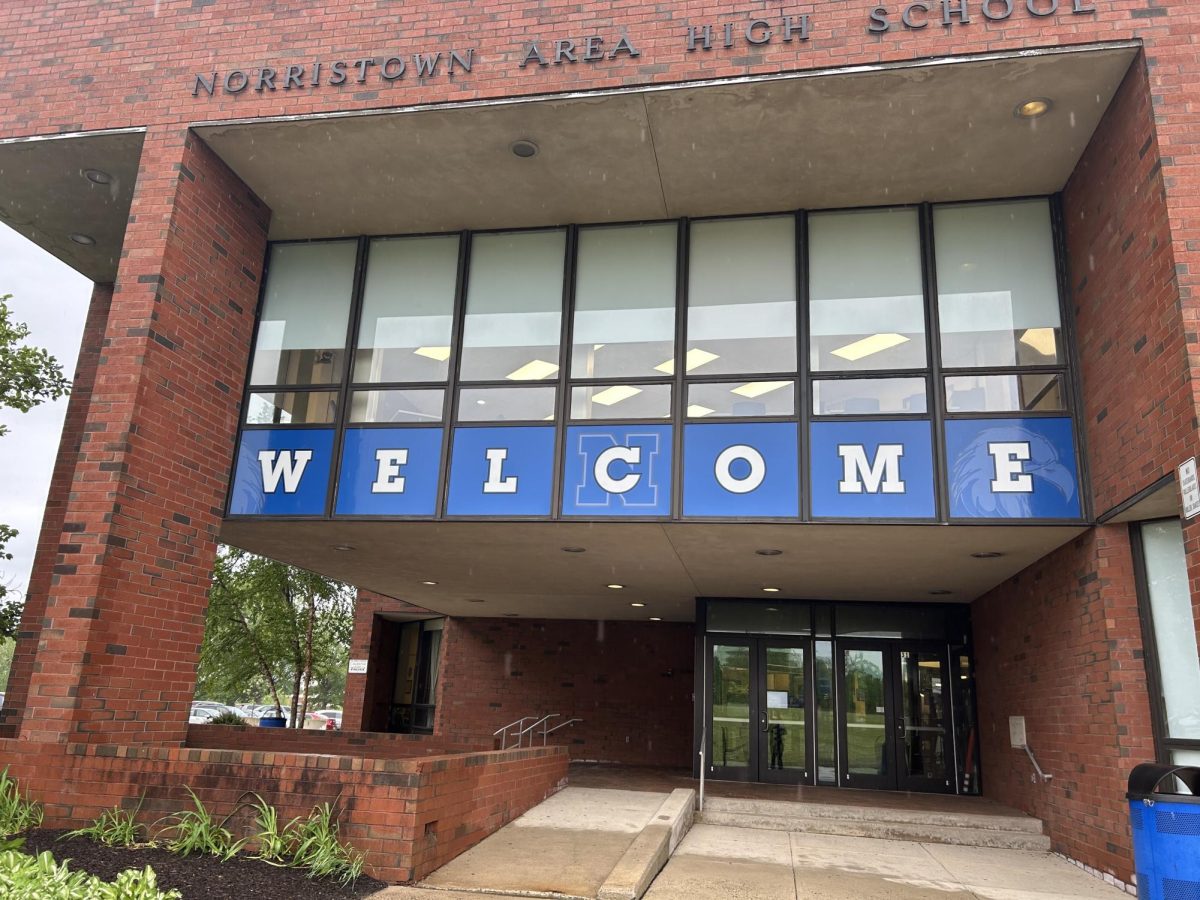
This, again, applies to our school. How can I trust that our school’s events are all that they’re made out to be when they aren’t even putting any effort into promoting them? And this is without even pointing out the hypocrisy of the school and teachers discouraging AI usage from students when they themselves use it.
How am I to take our school seriously when those using AI are basically hypocrites? How does anyone expect students to not use AI when the school uses it—or at least lets it pass—to promote events and dates?
AI requires next to zero thought, time, or work, so it doesn’t deserve any of mine.






Evan Bartlett • May 29, 2026 at 10:05 am
As a counterpoint, we need to look at this from the perspective of our overworked teachers.
Expecting a teacher to spend their limited free time learning and using image editing software for a routine announcement poster is unrealistic. Many of them are balancing heavy grading workloads, lesson planning, their own families, and children at home.
Furthermore, the article lumps all staff together, but the reality is that most teachers do not use AI, and absolutely none use it for everything. For the few who do utilize it, AI is simply a tool to manage a busy day. If technology can save a teacher fifteen minutes on a promotional flyer so they can focus on actual teaching, they absolutely should use it.