Skip to Content

‘The Special Men:’ How A Song Can Find Its True Meaning Through Its Cover

“Ziggy Stardust” originally was by David Bowie, but became a goth anthem ten years later.
'The Special Men:' How A Song Can Find Its True Meaning Through Its Cover
1972: Ziggy Stardust

Rock and roll has always had a toxic relationship with wants and needs. Typically, the rockstar starts off just wanting to make it big, one foot off the ledge of the rabbit hole, nibbling at the idea of fame. And when they make it, they fall like Alice. Their dream comes true and it’s pure gluttony. They make it big, and yet, it’s never enough. Their need for fame becomes a need for more: drugs, alcohol, money, sex, and other deviant outlets. And that toxic relationship is the reason they fall too far down the rabbit hole, not able to get out.

But that’s what makes rock and roll so great. Humanity is made up of sadists who enjoy seeing famous people fail, even if they think of celebrities as “idols.” Maybe it comes from the fact they were bullied in grade school by popular kids (adoring them yet needing revenge), maybe it’s the need to be reassured that someone is doing worse than them, or maybe, humans like seeing “perfection” being brought down to their level.

David Bowie, unlike the other rockstars of his era, didn’t fall as much and, from what he did fall into, he was able to climb out of, which is a rare phenomenon. After the release of his 1972 album, “The Rise and Fall of Ziggy Stardust,” which, ironically, is about a rockstar falling down the rabbit hole after reaching such a level of fame, just like Ziggy Stardust, a character created by Bowie for the album, Bowie reaches the same fame and falls down that same hole.

By the mid 70s, Bowie had developed an addiction to coke, severe mental health issues and sleep deprivation, lived off of only peppers and milk, and believed that witches were trying to steal his bodily fluids for occult purposes. His fame had made him reach for more, which then, became too much.

Unlike Moon, Hendrix, Presley, Vicious, and too many more, Bowie’s problems never actually led to completely losing himself or his death. Ziggy Stardust, however, was “killed.” Well, it was more of a retirement, but Bowie would never bring back the character. When The Rise and Fall of Ziggy Stardust first came out, Bowie became obsessed with the persona of Ziggy, which would bleed into his personal life. He was losing himself to Stardust. Bowie knew he had to “kill” him.

Bowie’s escape from Ziggy was an attempt to escape from his own personal hell, from the milk and peppers, from the drug induced psychosis, from the fame that was slowly killing him, just like Ziggy’s fame. He believed that Ziggy’s life was bleeding into his own.

Announcing that Ziggy wouldn’t be coming back during a concert in July of 1973, Bowie said, “Of all the shows on this tour, this particular show will remain with us the longest, because not only is it the last show of the tour, but it’s the last show that we’ll ever do.” Many took that as Bowie’s last concert, but it was only Ziggy’s. That night Ziggy died and would not be reborn until 1982.

It would take 20 more years for Bowie to get sober, and after “killing” Ziggy, in the mid 70s, his psychosis and drug addiction would get worse. Ziggy’s life wasn’t bleeding into Bowie’s life, rather, Ziggy’s would influence him even more, even if seemingly “dead.” However, in 1993, after marrying his wife, Bowie decided to get sober.

Ziggy Stardust is a androgynous alien from outer space who arrives at an Earth that is slowly dying. People can no longer listen to rock because there is no electricity. Ziggy, a rockstar, starts to write songs about a starman who will save the planet, which brings the people of Earth hope. Ziggy becomes famous and wants to reach not only people from Earth, but other planets as well. After becoming a sort of Jesus-esque figure, he becomes a victim of his own fame, which eventually kills him.

Ziggy was based on a myriad of rockstars, though Bowie’s main inspiration for the bisexual glam rocker was 50s rock and roll singer, Vince Taylor. Right before Bowie had met him, Taylor had a mental breakdown where he believed himself to be both an alien and a god, which set up the structure for who Ziggy Stardust would be. Taylor, who was popular for his Rock and Roll, lost himself to drugs, which became the core of Ziggy as a character.

In a 1990 interview with Q magazine, Bowie said, “[Taylor] always stayed in my mind as an example of what can happen in rock’n’roll. I’m not sure if I held him up as an idol or as something not to become. There was something very tempting about him going completely off the edge.”

The character would also draw inspiration from Bowie’s contemporaries such as Iggy Pop and Lou Reed. By melting all three together, Bowie had created a critique of a society that idolizes rockstars to the point they become messiahs.

Ziggy Stardust was introduced in Bowie’s fifth studio album, released in 1972, “The Rise and Fall of Ziggy Stardust” and would continue to be used as a stage persona for Bowie in concert until 1973. The album walks the listener through the story of Ziggy, yet there is one song that seems to be the only song on the album that tells his whole story in one song, titled “Ziggy Stardust.”

The song starts off with an acoustic riff followed quietly by a whiny electric guitar. The riff is memorable, imaginative, iconic, just like Ziggy is as a character. Then, slowly screaming in, is Bowie, who begins to set up a scene.

Ziggy began playing with a band called “The Spiders From Mars,” but eventually the fame got to Ziggy and the Spiders were left behind in Ziggy’s shadow, leading to them despising him. Becoming the “special man” of the band, Ziggy got all the fame, the women, and money, unlike the rest of the band’s members, who were seen as unimportant to him and even fans; “The Spiders From Mars” were Ziggy’s band with a few instrumentalists that are just replaceable. They aren’t iconic, they aren’t imaginative, they aren’t memorable, they aren’t lifted from a Christ-like pedestal like Ziggy is.

In the shadow that the Spider’s lived in, this song was written. The feeling of the lyrics, unlike the instruments themselves, is disdainful, but not exactly hateful, describing him as “making love with his ego,” which should say enough about who Ziggy is as a bandmate.

Ziggy’s story is a Shakespearean play, only it’s not a comedy with upsetting parts, but a tragedy that his fans are supposed to laugh at. For years, we have laughed at tragedies like Ziggy’s. Kesha, Britney Spears, Michael Jackson, and Brian Wilson are all examples of this. We as humans love knocking down perfection. We are meant to destroy and enjoy it.

So, of course Ziggy’s fans revel in his downfall. Not only is Ziggy an egomaniac, but his fans are megalomaniacs. They crave the power they have over Ziggy, even if it seems the opposite. Ziggy believes that “the kids were just crass, he was the nazz,” insulting his fans, but the fans have the power to destroy Ziggy, and they do it happily by the end of the song.

“The Rise and Fall of Ziggy Stardust” is the most literary albums to exist (sitting behind any Bruce Springsteen album), but this song, “ Ziggy Stardust,” even if the whole album is memorable, is a classic. Its soft guitars, somber and lively story, and Bowie’s iconic character of Ziggy (who seems like every rockstar everyone has ever liked into one), has allowed this song to not only be a song everyone knows, but everywhere in pop culture.

Ziggy Stardust may have died, but he was reborn again in 1982 by Goths.

1982: Ziggy Frankenstein

The OG Goths were ancient Germanic tribes that were responsible for bringing down the Roman Empire, and eventually, influencing medieval history and aesthetics. You could argue that the Visigoths or Ostrogoths also helped pioneer the modern Goth subculture, but the main groups who did were Siouxsie and the Banshees, Joy Division, and Bauhaus, who are nothing like the tribes.

The goths of today wear teased hair, teared fishnets, ankh necklaces and rosaries, and mostly black. They have an affinity for the dark and morbid such as death, literature like Mary Shelley’s Frankenstein or any piece of poetry from Poe, and the occult such as the supernatural. Goths’ listen to songs that sound like if Dracula made punk music.

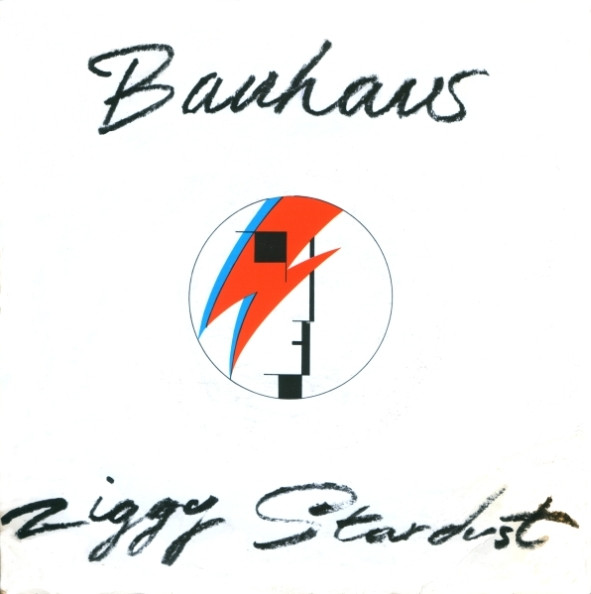
Bauhaus is a rock band from Northampton in England that formed in 1978. Named after the German art school and movement, Bauhaus certainly did help develop its own art movement, Goth. Bauhaus stood out though because of their cutting-edge sound, which was neither sad and quiet like post-punk nor atmospheric like early The Cure, but rather loud, aggressive, almost Bowie-like. Something darker, something more theatrical. They brought roaring, esoteric, outlandish sounds, becoming the one of the first gothic rock bands. Bauhaus also helped style the Goths, with their strict black and white stage presence and vampire-esqe looks, especially front man, Peter Murphy, who had everyone in the 80s sucking their cheeks in to get that “dead” look.

Many compared the band to David Bowie, even before their cover of “Ziggy Stardust.” Both Bowie and Bauhaus were deeply theatrical, dramatic, and avant-garde. Bowie and Murphy both looked similar and even sang similarly, which critics noticed. In fact, the song was covered because of the people and critics who had accused them of copying Bowie.

So when their cover of “Ziggy Stardust” came out, it surprised nobody with the fact they covered it, but how they covered it. They brought Ziggy back to life with electricity and eccentricity.

Glam Rock of the 70s was colorful, fun, and glam (duh), but Bauhaus’ gothic rock of the 80s highlighted a sense of paranoia and collapse of society. Bowie of the 70s performs Ziggy as a man who is ascending and getting bigger, while Bauhaus shows Ziggy as a man after the glitz and glam, after he has fallen. And somehow, Bauhaus is more Bowie than the Bowie version, with the loud guitars, nasally vocals and theatrics that both Murphy and Bowie have, and extreme rockstar energy that Bowie doesn’t really give in the original song. Bauhaus’ Ziggy Stardust is different. Frankenstein’s monster of music, except better, like The Rocky Horror Picture Show.

To understand Bauhaus’ Ziggy, you have to understand Murphy, whose story is ironically very similar to Ziggy’s, but unlike Ziggy, he was a Goth, not a glam rocker.

“I’m a thespian, I’m not an accountant. I can be very direct in an effort to break things down, but that doesn’t always work, and I’m not completely tactful. And I think, to be honest, I frighten the others,” said Murphy to Stephen Dalton for Uncut in April 2008.

Murphy became the face of Bauhaus, even launching into a pretty successful solo career because of it. But he fell into a self-obsession, into drugs, into alcohol, and into fame. This ultimately led to the band splitting up in the mid 80s. Murphy became the “special man” while the rest of the band were The Spiders From Mars. He was bold and odd, which both intrigued others and scared them away. He was what Ziggy Stardust warned audiences about in the 70s, and in the 80s, Ziggy was him.

“I do slip into the character, but it’s also like you’re watching a façade. You isolate yourself from that effect, from the audience worshipping you as a star,” said one of the members of the Bauhaus (unclear, but probably Murphy) to Mark Cooper for Record Mirror in October of 1982.

Ziggy reached stardom again in 1982 with the release of Bauhaus’ cover of “Ziggy Stardust,” which reached No. 15 on the British charts, even earning Bauhaus an appearance on the popular television show, Top of the Pops. The Sky’s Gone Out, the album that the cover is featured on, became the band’s greatest album success, peaking at No. 3 on the Charts. Bela Lugosi is dead, but Ziggy took the torch, becoming the goth icon.

“Bauhaus were regularly derided in the UK press for ripping off glam-rock artists. But Bauhaus didn’t really sound like T. Rex or David Bowie or Roxy Music. In their distaste for ingratiating melodies, and preference for raw power over fashion flash or ironic detachment,” wrote Ryan Maffei of Rock and Roll Globe in November 2022.

Unlike Bowie’s glam concert in a 70s club, full of sparkles reflecting off each other, patrons sipping on sweet cocktails full of love and lust, outfits that seem extra to the ordinary, “Ziggy Stardust” by Bauhaus starts with screeching guitars which give the song a feeling of being packed in a dingy basement, surrounded by the smell of cigarettes and beer and sweat, fueled by teenage rebellion. The loudness, the angst, the darkness just seem to fit the themes and lyrics of the song better than the original by Bowie (which is very hard to write because Bowie’s is amazing).

Bowie fails at what he was trying to go for in the song. This doesn’t mean the song is bad, but rock stars are supposed to be dirty and moody, not polished and neat. Bauhaus’ cover, however, pulls off the mood perfectly.

Even Murphy’s whiney lyrics make it sound like, rather than sharing a story, the Spiders are gossiping about Ziggy. Bauhaus’ version is completely hateful, while Bowie’s is somewhat praising, like a friend who you hated in the moment but now understand.

“Watch Bauhaus performing ‘Ziggy Stardust’ on TV. Every gesture is perfectly placed. Ziggy goes down on guitar, so too does Murphy. No trace of caricature or burlesque sours the Bauhaus version – their wit has been dimmed by the sort of seriousness that pre-empts parody. It’s a straight run through and, if it’s not note perfect, it manages to Xerox the shrill mood of the original accurately,” wrote Chris Bohn of New Musical Express in October of 1982.

Bauhaus just copies the vibe of Ziggy better than his creator. They understand him somewhat to an extent because they were living Ziggy’s reality; a front man who is lost in the limelight and a band who is lost in his shadow. Murphy, like Bowie, has always dealt with drug addiction, but never to the extent it stopped him from making music.

Bowie has always been a songwriter and artist. He had a band, but “David Bowie” has never been a band, just a man with a band behind him. Bauhaus has always been a band, each member no more important than the other. Bauhaus could understand the Spiders’ perspective, but Bowie could understand Ziggy’s.

Bauhaus understood who Ziggy Stardust was. Bowie knew him personally. This dynamic is seen in parents, who don’t understand their child but know who they are. Ziggy was Frankenstein, given a new, and even better life.

Bowie didn’t agree though. He thought of the cover as dreadful and even said, “I don’t think it was that successful” in a BBC radio interview in 1983. When asked about it in Uncut Magazine, Murphy, who is just Bowie but goth, said, “I don’t think [Bowie] liked it. But it was pure love for him. It was also us kicking against the vitriol in the press. You called us Bowie copyists, so this is the ultimate irony.”

Bowie’s song may be the original, but that doesn’t mean it grasps Ziggy Stardust’s energy in the same way that Bauhaus does. “I’m not quite sure they did a cover version,” said Bowie in 1983 to BBC. Bauhaus made Ziggy Stardust their own, gave him new life, and created almost a completely new song. “Ziggy Stardust” began with Bowie and was re-made with Bauhaus’ take on the song.

But either way, Bowie or Bauhaus, Ziggy Stardust lives on in other superstars who may be struggling. Ziggy Stardust is universal.

More to Discover